
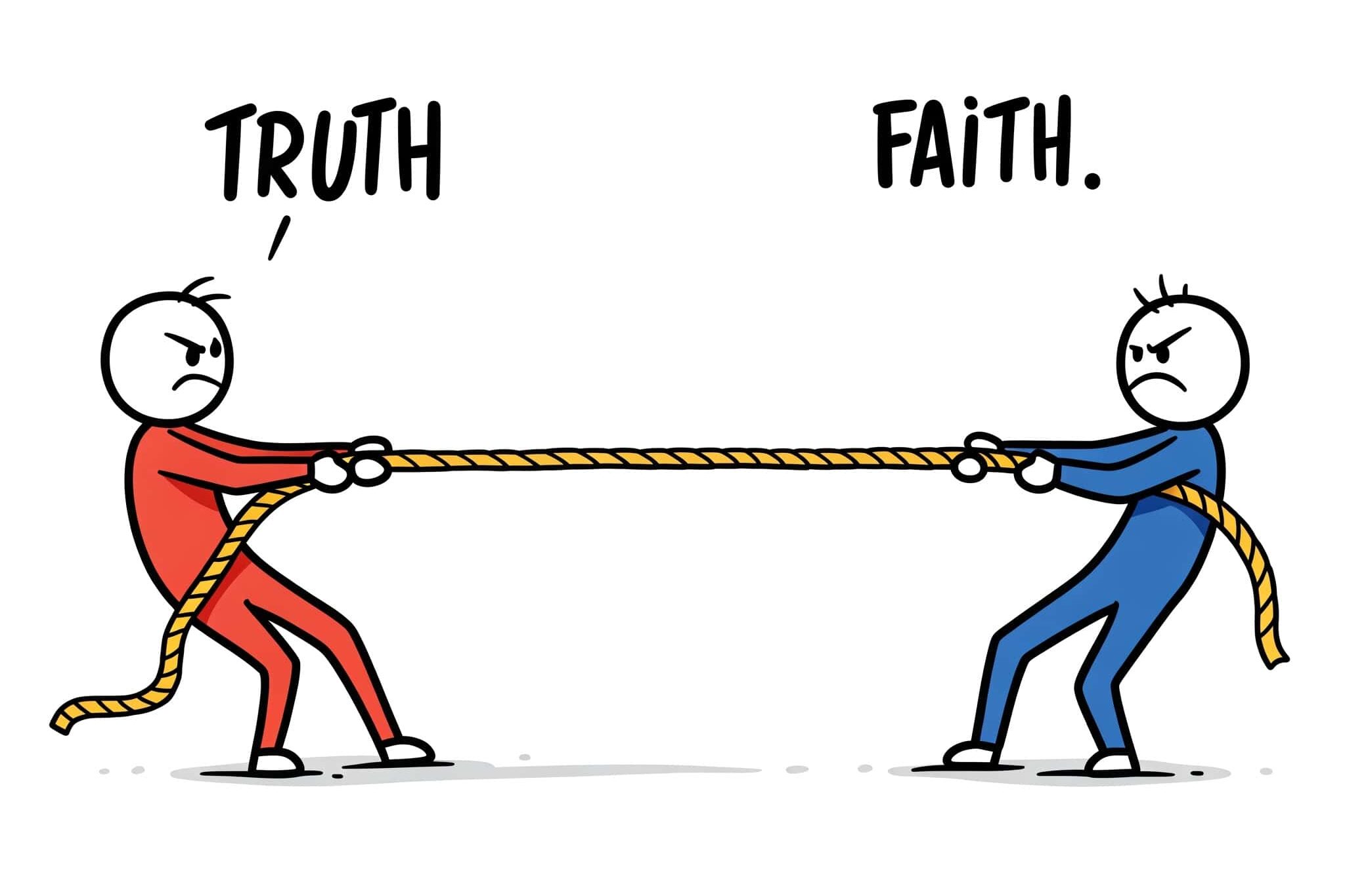
Truth and Faith are two words that carry multiple meanings depending on the context in which they are used. In many cases, their usage does not create conflict, but in other situations, they appear to be at odds with each other. Before delving into the conflict between truth and faith—specifically the pursuit of both—, it is important to establish what is meant by these terms in this discussion.
What is meant by Truth?
In this wiki entry What is Truth, I laid out the philosophical understanding of truth: it is that which is in accordance with fact or reality. This aligns with what most people intuitively mean when using the word truth. When we say, “That’s true,” we are asserting that a particular belief, statement, or proposition accurately represents reality.
Thus, the pursuit of truth is the endeavor to form beliefs that accurately represents reality. There are two key aspects of the pursuit of truth that should be highlighted (will be further elaborated in future wiki entries):
- Human epistemic limitations: We are constrained by our human limitations and will never be fully certain that our beliefs are true.
- The pursuit of truth involves two key components*:
- Ensuring that the confidence we have in a belief is proportionate to the strength of the evidence supporting it.
- Actively seeking more evidence to refine and strengthen our beliefs.
*(i) is more relevant as (ii) depends on the relevance/usefulness of the belief
What is meant by Faith?
In this wiki entry What is Faith, I laid out the biblical view of faith as a feeling of certainty/trust directed towards something, hoped for, that is not fully perceived or understood.
However, when someone says, “you need to have faith”—in other words, pursuing faith—, they might mean one of the following
- Have or increase the feeling of trust, with no relation to the means to obtain it
- Increase the feeling of trust, beyond the level available evidence provides
- Increase the feeling of trust to the level that available evidence provides
In conversations I have had, it is often unclear which of these meanings people adopt. For the purposes of this article, I will use the second definition since it aligns with the faith described in the wiki entry.
In this article, I will use the following terms as defined below:
- Evidence-confidence: confidence in the truth of a belief that arises from supporting evidence.
- Faith-confidence: confidence in the truth of a belief that does not arise from evidence.
- Total-confidence: the sum of evidence-confidence and faith-confidence.
Why Marry Truth and Faith?
Both the pursuit of truth and the pursuit of faith play significant roles in our lives.
Seeking truth enables us to make well-informed decisions that effectively guide us toward our goals. In matters with serious consequences, truth should take precedence over faith—for instance, in determining criminal sentences or managing dangerous technologies.
Meanwhile, the pursuit of faith—whether or not it is rooted in religion—contributes to personal motivation and relationship-building. In these areas, confidence based on faith can complement confidence grounded in evidence. For example:
- People are naturally drawn to those who exude confidence, as it signals self-assurance and competence.
- Trust tends to be reciprocated; when you trust others, they are more likely to trust you in return.
The Conflict Between the Pursuit of Truth and Faith
Pursuing faith discourages proportioning confidence with evidence
One aspect of pursuing truth is to ensure that the level of evidence-confidence in a belief matches the strength of the available evidence. Confidence levels would vary from person to person, as individuals have access to different amounts of evidence when assessing the same belief or proposition.
The standard of confidence to make decisions to use may differ based on the context. Different standards of proof (from high to low) is described below:
- Beyond reasonable doubt: proof of such a convincing character that one would be willing to rely and act upon it without hesitation in the most important of one’s own affairs (does not mean that there’s no doubt)
- Clear and convincing evidence: a level of proof such that a claim is substantially more likely to be true
- Preponderance of the evidence: a level of proof such that that a claim is more likely to be true
As Christians, we are called to pursue faith, specifically faith-confidence. However, I have observed that some fail to carefully distinguish between faith-confidence and evidence-confidence, often conflating the two. This issue is further compounded by the way we construct beliefs upon other beliefs. For example, if a foundational belief like “God does not lie” is accepted based on faith-confidence, then subsequent beliefs, such as “God will fulfill this promise,” are also adopted through faith-confidence rather than evidence-confidence. While this distinction may be clear when dealing with a single layer of belief, it becomes increasingly difficult to assess when multiple layers are involved.
It can be challenging to determine the proportion of evidence-confidence and faith-confidence one has in a belief, thus making it difficult to evaluate whether one’s evidence-confidence aligns with the strength of the available evidence.
Pursuing faith conflicts with pursuing evidence-confidence
For someone who desires faith, the main goal would be to increase faith-confidence—confidence in the truth of a belief that does not arise from evidence. There is a limit to the amount of confidence that one could have of a belief, which is complete confidence. As such, the more faith-confidence that one has, the less room one would have for evidence-confidence, vice-versa.
Furthermore, obtaining evidence-confidence requires significant effort: carefully evaluating evidence, considering counterarguments, and continuously refining one’s beliefs. Faith-confidence, particularly in the Christian context, is often described as a free gift from God. If one can achieve high total-confidence more easily through faith-confidence, there is less motivation to pursue evidence-confidence.
Unfortunately, this is a inherent conflict and thus can never be resolved.
Marry Truth and Faith by separating them
Just like how we separate work from home to relax well at home and work efficiently, separating faith and truth can prevent unnecessary conflict between them.
This does not mean ignoring the pursuit of truth in areas where one pursues faith. Rather, it means clearly distinguishing between faith-confidence and evidence-confidence. For example, one may have faith-confidence that a friend will return borrowed money despite contrary evidence-confidence. Being mindful of this distinction helps prevent biases in evaluating evidence-confidence.
A practical guideline could be:
- When engaging in truth-focused discussions (e.g. science, legal matters), avoid introducing faith-confidence.
- When engaging in faith-focused discussions (e.g. theology, religious topics), avoid presenting faith-confidence as if it were evidence-confidence.
- In areas where total-confidence is involved (e.g. apologetics—conversations between believers and non-believers), be explicit about what portion is derived from evidence-confidence versus faith-confidence.
How this manifest in MTF
MTF’s wiki structure is categorized into 3 categories
- Theology (Category) – faith-focused category, taking it on faith-confidence that biblical teachings are true.
- Foundation (Category) – truth-focused category, providing key background knowledge based on evidence-confidence
- Apologetics (Category) – where truth and faith coexist
Apologetics is where truth and faith coexist, a reasoned defense of the faith. There are instances where a truth-centered approach reveals evidence that challenges theological teachings. From what I’ve observed on other platforms, apologetic defenders often confuse faith-based confidence with evidence-based confidence. MTF aims to avoid this distinction: if a belief lacks supporting evidence, it simply cannot be considered supported by evidence.
Similarly, in theology, while faith is central, truth should be considered as well. For example, teachings that seem contradictory should be acknowledged as such. Even if one could conceive of a context where they might not appear contradictory, if the context of those passages clearly reveals a contradiction, it should be accepted as contradictory. In the situation where two contradictory belief are held on faith-confidence, a revision must be made to reject either one of it. Evidence-confidence demands that both beliefs could not be true at the same time, there’s no room for faith-based confidence in such a context. Faith-based confidence only apply when there is a lack of evidence-confidence.
Leave a Reply