Category: Articles

  • The Bible About Itself: Inspiration, Inerrancy, and Unity

    The Bible About Itself: Inspiration, Inerrancy, and Unity

    In establishing my methodology for biblical interpretation in Biblical Hermeneutics and Exegesis, I assumed the following

    • Divine inspiration and authority: God is the ultimate source of Scripture, yet He worked through human authors with distinct personalities, vocabularies, and historical contexts.
    • Biblical inerrancy: The Bible, in its original manuscripts, is wholly without error in everything it affirms.
    • Canonical unity: Scripture forms a coherent whole, presenting a unified narrative of God’s redemptive purposes.

    In this wiki entry Bible’s Claims About Its Own Nature, I explored the biblical support for these three assumptions. That entry focuses on what Scripture says about itself and does not directly engage broader debates concerning the Bible’s reliability. The Bible’s self-testimony is only one component of the larger and much-discussed question of whether Scripture should be trusted. Other relevant considerations include:

    • How can we determine whether a given interpretation is correct?
    • How closely do the biblical manuscripts we possess correspond to the original texts?
    • Can the historical process of canonization be regarded as reliable?
    • Is the Bible consistent with other sources?

    In this article, I want to write mainly about two thoughts on the Bible’s claims about its own nature.

    The Argument for Biblical Inerrancy

    The argument for inerrancy can be distilled into two main points (see Bible’s Claims About Its Own Nature for the details)

    1. The Bible is God’s Word
    2. God’s Word is inerrant (God cannot lie, is omniscient and omnipotent)

    The primary point of disagreement concerns the first claim. In the referenced wiki entry, I outlined both the case for understanding the Bible as the Word of God and the opposing neo-orthodox position, which regards Scripture as a human witness to the Word of God rather than the Word itself. The core of the debate lies on differing conceptions of the nature of divine inspiration and the mode by which God speaks through the biblical text.

    Personally, I have not read too deeply into the neo-orthodox viewpoint. Nevertheless, based on my current reading, I am more inclined toward the orthodox view that Scripture itself is properly understood as the Word of God.

    Spoken Inerrancy Does Not Automatically Entail Written Inerrancy

    Many biblical texts that are commonly cited in support of inerrancy pertain more directly to spoken revelation than to written Scripture. The claim that the Bible is the Word of God rests primarily on the doctrine of divine inspiration. Scripture is quite clear that when God speaks through prophets, the words uttered are divinely inspired and therefore inerrant (2 Peter 1:20-21). However, these passages primarily address prophetic speech, not the subsequent processes of recording, compiling, or editing those words into written form.

    It is true that Scripture sometimes employs phrases such as “for it is written” (Romans 14:11; 15:4; Matthew 4:4; 1 Kings 2:3). However in nearly all such cases, this phrasing functions as a way of appealing to authoritative Scripture or words, rather than as an explicit claim about the mode of inspiration being tied to the act of writing itself. For example, in 1 Kings 2:3, David refers to the written decrees, commands, laws, and statutes contained in the Law of Moses. However, we know that these texts originated from God speaking to Moses, or Moses speaking under divine instruction, before being committed to writing. The authority of the written form, therefore, appears to derive from the prior divine speech it preserves, rather than from an explicit claim about inspiration being located in the physical act of writing.

    Jeremiah 36:1-4 documents an instance of how spoken words were transformed into written text. Jeremiah receives God’s words and speaks them, while Baruch records them on a scroll. The text explicitly states that Jeremiah was divinely inspired to speak, but it does not state with equal clarity that Baruch was inspired in the same way in the act of writing. The chain of transmission—God to Jeremiah, Jeremiah to Baruch, Baruch to the scroll—raises a legitimate question about whether inerrancy applies equally and explicitly at each stage of this process, based solely on this passage.

    Similarly, texts that describe words spoken by followers of God as being guided by the Holy Spirit (e.g. Acts 4:25; Hebrews 1:8-9; Matthew 22:43-44) overwhelmingly concern prophetic utterance. They do not, on their own, clearly extend that inspiration to the later act of documenting those words.

    Clear Scripture Support for Written Inerrancy

    There are two main texts that lends strong support to written inerrancy: 2 Timothy 3:16 and Matthew 5:17-18.

    In the wiki, I mentioned that as a result of its rare usage, there is a debate on whether the Greek word theopneustos in 2 Tim 3:16 should be interpreted passively as “breathed out by God” or actively as “life-giving”. I believe that in light of the Matthew 5:17 and other supporting passages in the Bible, even if the author intended to describe Scripture as life-giving, there would still be sufficient evidence to conclude that Scripture is also God-breathed.

    In Matthew 5:17, Jesus emphasized that even the smallest details/word (in the Old Testament) matter and the phrasing used suggest that it refers specifically to the written text. In other words, every choice of letter or word used would have been inspired by God, and thus inerrant.

    In Matthew 19:4-5, Jesus quoted Old Testament Scripture (Matt 19:5) and explicitly describes it as God’s words despite the fact that the original passage (Gen 2:24) in Genesis is written as narrative rather than direct divine speech. This clearly supports that even the descriptive or commentative text within the part are God’s word.

    Taken together, these passages provide a more direct and compelling biblical basis for affirming written inerrancy, extending divine inspiration beyond prophetic utterance to the textual form of Scripture itself.

  • Revisiting Biblical Hermeneutics

    Revisiting Biblical Hermeneutics

    In my previous blog post, I shared that I would like to reprioritize to establish a solid theological foundation. To do that, I would need to first set up a good methodology by which I do so. For most Christians, including myself, we believe that the Bible is the word of God and most, if not all, of our theological knowledge comes from the Bible. Thus, the methodology that I would need to establish would be on how I should read and interpret the Bible.

    This is an especially important endeavor in my opinion. In my own interactions with believers, I find that I often disagree with them on how some biblical text should be interpreted. Sometimes, we have the same principles that we may abide by, the difference in opinion in this case may stem instead from how well we understand and apply those principles. But at other times, the disagreement arises from having fundamentally different interpretive principles altogether. Almost all of us would recognize that there are huge doctrinal disagreements among believers, the only way to resolve this, in my opinion, is to first agree on how we should interpret the Bible. If Scripture does not speak clearly on a given doctrine after applying sound interpretive principles, then the wisest stance is to withhold dogmatic certainty.

    To strength my understanding, I read How to Read the Bible for All Its Worth by Gordon D. Fee and Douglas Stuart, along with various other resources and updated the wiki entry Biblical Hermeneutics and Exegesis. My focus, however, leans toward propositional and doctrinal interpretation. Therefore, in the wiki entry, I have written less about poetry and wisdom literature, whose purposes are more oriented toward guiding worship and shaping godly living.

    Those interested in a fuller overview of hermeneutics may refer to the wiki entry. In this article, I want to reflect specifically on the practice of exegesis.

    The threat of Eisegesis

    Eisegesis is the interpretation of a text by reading one’s own preconceived ideas, biases, or assumptions into it, rather than drawing the meaning out from the text itself. Almost everyone would agree that exegesis is the right way to interpreting a text. However, none of us are immune to unintentionally allowing our biases to color our reading.

    In a recent Bible study discussion on Matthew 6, I raised a question concerning Matthew 6:33, which appears to promise that God will provide basic physical necessities—food, water, and clothing—to those who seek His kingdom and righteousness first. My question was how we should reconcile this promise with the observable reality that some seemingly sincere Christians die from starvation, malnutrition, contaminated water, or a lack of weather-appropriate clothing. The uncomfortable implication is that those individuals were hypocrites and not truly seeking God’s kingdom first.

    In response, several fellow believers argued that Matthew 6:33 should be interpreted in light of the broader context of Matthew 6, where Jesus emphasizes prioritizing heavenly rewards over earthly concerns. They suggested that the verse is not a promise of physical provision, but an exhortation not to be overly concerned with material needs.

    I agree that literary context matters. However, the broader context does not negate the plain meaning of Matthew 6:25–34, which clearly asserts that God provides these basic necessities for those who seek Him. Jesus explicitly grounds this reassurance in God’s care for birds and animals. The two points—prioritizing heavenly things and trusting God for earthly provision—are not mutually exclusive.

    From this exchange, my impression is that the reinterpretation arose, at least subconsciously, from an attempt to reconcile the passage with the troubling reality that there appear to be situations that God did not fulfill the promise of earthly provision. This, I think, is an example of how all of us—myself included—can inadvertently bring in personal bias into a text rather than allowing the text to speak on its own terms.

    What’s next?

    In forming a methodology for biblical interpretation, it necessarily involves an interpretation or understanding of Scripture, specifically about how it ought to be read. My next step is to consider what the Bible itself teaches about the core assumptions underlying this methodology:

    • Divine inspiration and authority: God is the ultimate source of Scripture, yet He worked through human authors with distinct personalities, vocabularies, and historical contexts.
    • Biblical inerrancy: The Bible, in its original manuscripts, is wholly without error in everything it affirms.
    • Canonical unity: Scripture forms a coherent whole, presenting a unified narrative of God’s redemptive purposes.
  • New Focus: Christian Foundation

    New Focus: Christian Foundation

    It has been a long time (~7 month) since my last article post in April where I started writing wiki entries on “Did God lie”. From the beginning, I knew that addressing this topic comprehensively would require a significant investment of time, especially since the study involves reading and examining Scripture from cover to cover. Still, I felt it was worthwhile to begin the journey.

    Update on “Did God Lie”

    Progress has admittedly been slow. So far, I have only completed a full review of Genesis and a small portion of Exodus. For those interested, you can read the related entries at “Did God lie”.

    Aside from one case (Does Exodus contradict History?), most instances that initially seemed to depict God as lying can be reasonably explained. However, it is important to emphasize that my work so far barely scratches the surface.

    Pivoting to Christian Foundations

    Recently, I’ve come to realize something important in my own spiritual walk: I lack a strong, structured, scriptural grounding for many of the foundational beliefs I hold. These include doctrines like the Holy Trinity, salvation through faith and authority of Scripture.

    This realization led me to rethink my immediate priorities. While the “Did God lie?” project remains valuable—and I fully intend to continue it—I believe it is equally, if not more, important to first establish a solid theological foundation.

  • Conflict: Science and Genesis 1-2

    Conflict: Science and Genesis 1-2

    In my first investigation on the topic of Did God Lie, I arrived at the conclusion that the apparent contradiction between the creation account narratives in Genesis 1 and 2 were a result of misinterpretation.

    However, in my second investigation on Does Genesis 1-2 contradict science?, it appears to me that there is a tension between what we know from Science and what we know from a proper interpretation of Genesis 1-2.

    The Tension

    There are two main point of tensions that I observed from my investigation:

    1. A literal interpretation of Genesis clearly contradicts what we know from Science about the cosmological history of the universe and the history of life. However, it is unclear whether Genesis is meant to be literally interpreted.
    2. The presence of carnivorous animals before man contradicts even a non literal interpretation of Genesis.

    Literal interpretation of Genesis contradicts Science

    At this point, I haven’t reached a firm conclusion on whether Genesis was intended to be interpreted literally. There is a wide range of scholarly opinion, though most contemporary biblical scholars seem to favor a non-literal approach. Based on what I’ve read so far, my tentative view is that Genesis 1–2 may have been written with both a literal intent and a strong theological purpose (which is against the scholarly opinion).

    Here’s a quick summary of both approaches

    • Literal: Genesis 1-2 describes real historical events, and the six days of creations are 24-hour days
    • Non-literal: Genesis 1-2 is a theological or literary account—the six days are symbolic, analogical or part of a literary framework. (events may not have occurred as described)

    If Genesis is meant to be interpreted literally, a contradiction with scientific findings becomes difficult to avoid.

    • Cosmological History of the universe
      • Genesis: Earth was created before the Sun and stars.
      • Science: The Sun and stars formed before Earth.
    • History of Life
      • Genesis: Plants and animals created in 24-hour days
      • Science: Plants and animals evolved from unicellular organisms over a long period of time

    There are essentially two ways to reconcile this tension, argue that:

    1. What we know from Science is wrong
    2. What we know from Bible is incomplete

    The first way is to challenge the methodology and evidence used to derive the conclusion in question. While there are some critiques in this area, the prevailing scientific consensus considers the evidence for the age of the universe and evolution to be strong and reliable. I haven’t explored this route in depth, but may revisit it in the future.

    The second way is to suggest a plausible explanation for the apparent contradiction observed. The one listed in Does Genesis 1-2 contradict science? is the apparent age theory which suggests that God could have created the world with an appearance of age, such that it aligns with both Genesis 1-2 account and the scientific evidence gathered. While this is logically possible, this does not seem likely and there is no evidence in the Bible suggesting this.

    Given these points, if Genesis was intended to be taken literally, there does appear to be a meaningful conflict between the biblical text and scientific understanding.

    Carnivore animals before man

    Even in a non-literal interpretation of Genesis, Genesis 1:29-31 suggests that animals were herbivores before man were created. (see here)

    This issue presents a deeper tension for me than the previous one. While the earlier concern could potentially be resolved by adopting a non-literal interpretation of Genesis—a view I’m not fully convinced by but still consider plausible—the explanations I’ve encountered for this particular point seem less persuasive.

    Similar to any scientific critique, a defense could be made by challenging the methodology and evidence used to arrive at the conclusion. However, the general consensus seems to be that the conclusion that there are carnivorous animals before man seem reasonable.

    Another way to resolve the contradiction is by arguing that the interpretation of Genesis 1 does not necessitate that animals only ate plants and that natural processes like predation for animals, but not humans, were part of God’s good creation, to bring about life’s diversity through evolution. However, if we consider the context that the writer and audience were in, Genesis 1:29-31 would have been intended to communicate that animals were originally intended to eat plants only and that, it did occurred as intended.

    Handling the tension

    If we only consider Genesis 1-2, I think it would have been unreasonable to conclude that God is real. While Science is fallible, the general methodology and approach is one that’s truth seeking—it is reasonable to hold tentatively to the conclusions we know from science.

    Thankfully, for most believers, faith in God doesn’t rest entirely on Genesis 1–2. It rests on a broader foundation that includes personal experiences of God, spiritual transformation, and the reliability of the Bible as a whole. This foundation can help us navigate areas of uncertainty or apparent contradiction.

    Still, like an airplane that can survive isolated system failures but crashes when too many failures occur, our faith could falter if too many foundational beliefs were undermined.

    Regardless, for those committed to seeking truth, intellectual honesty means acknowledging when there are real tensions—such as the presence of carnivorous animals before humans—between scientific knowledge and scriptural interpretation.

  • A Closer Look: God Does Not Lie

    A Closer Look: God Does Not Lie

    In an earlier article and wiki entry, I’ve briefly explored what the Bible teaches about truth and faith.

    Now, I want to explore each teaching in greater detail, starting with the teaching that God doesn’t lie.

    My Interest in the concept of lying

    Lying—intentionally communicating something believed to be false—has always intrigued me, especially from a moral perspective. While most people can easily identify situations where lying is clearly wrong, there are instances where the morality of lying becomes more complex, with debates over whether it might be justified in certain circumstances.

    Furthermore, there are also “variants” of lying—such as lying by omission or misleading without expressing something false—that also have questions on whether it’s justified.

    It could be argued from the Bible that, to some extent, God Himself may have engaged in some “variants” of lying. For instance, in the Book of Job, Job asks why he, a righteous man, is suffering so much. However, God’s response is a series of questions that highlight the vast difference between God’s sovereignty and Job’s limited understanding, ultimately leading to Job’s humility. While what God says is truthful, He does not directly answer Job’s question, and we know that the reason behind Job’s suffering is rooted in the wager between God and Satan in Job 1-2 (which would answer Job’s question).

    This is akin to a situation that we may commonly observe

    • Employee: why haven’t I been promoted?
    • Employer (politically correct answer) : because you didn’t fulfill the criteria of …

    While the politically correct answer would be answering the question, it could also distract the employee from the main contributing reason, such as discrimination based on protected characteristics (like race, gender), favoritism or being threatened by your competency.

    However, it may be unfair to draw such a conclusion in Job’s case (or any other case pertaining to God). God’s intentions may be pure, and His response wasn’t meant to obscure the truth in the same way that human misdirection might.

    The Amazement of the claim

    Most of us have lied at some point, whether for nefarious, benign, or noble reasons. If someone claims they’ve never lied, we might assume they’re lying again.

    Considering God’s eternal nature, He has had far more opportunities to lie than we have. To claim that God has never lied in His entire existence is an extraordinary statement. This claim carries profound implications—it suggests that we can fully trust His words and promises, a cornerstone of the Christian faith.

    Investigating the claim

    While Christians believe that God doesn’t lie, there are counterexamples presented by critics to argue that God may have lied—expressed something false or did not fulfilled a promise.

    Counterexamples can come in the form of:

    • Internal critique: cross-examine within the Bible
    • External critique: compare the Bible against what we know outside of the Bible

    The detailing of the counterexamples and defense would be my focus for the upcoming articles and wiki entries.

    See Did God lie?

    First investigation: Genesis creation accounts

    My approach will be chronological, beginning with Genesis, then moving through the Old Testament and into the New Testament, to identify key topics for further investigation.

    The first issue I want to explore is whether there is a contradiction between the two creation accounts in Genesis. A superficial reading of Genesis 1 and 2 might suggest a contradiction in the order of creation—particularly with the creation of animals, plants, and mankind. However, upon closer examination, many of these apparent contradictions can be reasonably resolved.

    What I’ve learned from this investigation is that understanding the context and language of a passage is essential for interpreting its meaning accurately. Unlike other books, the Bible was originally written in Hebrew and Greek, and its translation into English may result in some nuances being lost. Even different translations of the same verse can reveal different interpretations.

    See Do the two Genesis creation accounts contradict?

    In my next article and wiki entry, I will be looking at another commonly discussed external critique: Science contradicts Genesis creation accounts.

  • Scripture Interpretation must be Truth-Focused

    Scripture Interpretation must be Truth-Focused

    Philippians (NKJV) 4:13
    I can do all things through Christ who strengthens me.

    This verse, taken out of context, may be misinterpreted as being able to do anything because Christ has empowered them. However, a simple reading of the Philippians 4:10-12 would reveal that the “all things” that Paul is referring to is being content in whatever circumstances that he is in, both in abundance and in need.

    Why Scripture Interpretation must be truth-focused

    For most believers, the Bible—the Word of God—is the ultimate authority in their lives. Therefore, how one interprets the Bible directly influences their understanding of God’s will and instructions. An inaccurate or incorrect understanding, could lead one to act in ways contrary to God’s intentions. Sound biblical hermeneutics ensures that Scripture is interpreted faithfully and accurately.

    Is there a true way to interpret?

    Exegesis is the interpretation of the Bible by a critical objective analysis of the text to determine the original context and meaning. This is often contrasted with eisegesis, which is the interpretation of the Bible based on a subjective analysis of the text. Clearly, exegesis is the true way to interpret—the meaning of the text is determined by its author, not the reader.

    Although we cannot directly access the author’s thoughts, established principles of interpretation allow us to more likely discern the author’s intended meaning. Therefore, the correct way to interpret Scripture is the one that follows these principles.

    When individuals or groups disagree on the meaning of a passage, the best way to resolve the discussion is by justifying their interpretation through these principles (and not through faith). However, in some cases, even after thorough discussion, the available evidence may not provide a conclusive interpretation. In this situation, this would mean that neither party has the right, on biblical grounds, to reject the other’s interpretation.

    These principles include considering the type of text, the writer’s intentions, context and the language of the text.

    For a more detailed discussion, see the wiki entry on Biblical Hermeneutics and Exegesis.

    Where does faith come in?

    Interpretation allows one to understand the meaning of a biblical text, but understanding alone does not equate to belief. Faith, then, is what enables a person to accept and trust what is being communicated by the author. While exegesis helps uncover the meaning of Scripture, faith is what compels a person to believe and apply Scripture in their life.

    Not everything in Scripture is true

    The Bible is a collection of 66 books, written by different authors over a period of around 1500 years. Each writer wrote from a different perspective, to a different audience. While we know from 2 Timothy 3:16 that all scripture is God-breathed, it does not mean that everything in Scripture is true. Scripture includes content expressed by people, including praise, worship and teachings—unless explicitly stated as coming from God.

    Since human beings are fallible, the words and perspectives expressed by them may not always be true. For example, in the book of Job, Job and his friends made statements that God later corrected. However, such corrections are not always provided throughout Scripture.

    Therefore, even with a correct interpretation of Scripture’s meaning, one must still carefully evaluate whether the content is actually true.

  • God values both Truth and Faith

    God values both Truth and Faith

    In my previous blog post Marry Truth and Faith by separating them, I discussed some practical reasons to marry truth and faith.

    In this post, I aim to examine what the Bible has to say about pursuing both truth and faith, and whether it presents a conflict between these two concepts.

    For clarity, I will continue to use the following terms in this article:

    • Evidence-confidence: confidence in the truth of a belief that arises from supporting evidence.
    • Faith-confidence: confidence in the truth of a belief that does not arise from evidence.
    • Total-confidence: the sum of evidence-confidence and faith-confidence.

    God on truth

    See this wiki entry for other biblical teachings about truth (What does the Bible say about Truth?)

    The Bible clearly presents God as one who:

    • keeps His promises, doesn’t lie and is not one that would change his mind (1 Samuel 15:29)
    • hates people who lies and deceives (Proverbs 6:16-19)

    The Bible also clearly commands us to:

    • seek evidence for our beliefs (1 Thessalonians 5:20-21)
    • not lie, deceive or give false testimony (Zechariah 8:16-17)
    • fulfill our vows and promises (Ecclesiastes 5:4-6)

    What is less clear is what the Bible teaches about God’s stance towards

    • those who genuinely seek the truth but still fail to arrive at the true belief
    • alignment between confidence in a belief to the strength of the evidence supporting it

    God’s stance towards genuine seekers that hold false beliefs

    The Bible contains many passages about seeking knowledge and understanding, especially in Proverbs, a book focused on gaining wisdom and insight. Most of these passages link false beliefs to insincerity. For example, Proverbs 1:28-29 highlights how those who reject wisdom lack a genuine desire to seek truth. Similarly, Matthew 13:10-15 also brings across the point that God hides knowledge from those that are not sincere in their search for understanding. From this, we can infer that those who sincerely seek the truth will be able to understand it. This implies that if we approach God with the right attitude, He will guide us toward true beliefs, particularly in relation to God and Christianity (John 16:13).

    Only one passage comes to mind that lays out God’s stance towards genuine seekers with false beliefs: Romans 14. In this chapter, Paul discusses disputable matters (Romans 14:1), using issues like food and the observance of sacred days as examples (Romans 14:5). God’s position on these matters is as follows:

    • it is God alone to judge, we should not judge each other (Romans 14:4)
    • we should make every effort to do what leads to peace (Romans 14:19)
    • He judges based on what we believe, or have faith in (Romans 14:5-9, 14:22-23)

    Disputable matters arise because of a lack of evidence-confidence. If clear evidence supported one viewpoint, there would be no dispute. Romans 14 suggests that on disputable matters, God places more emphasis on our beliefs (and the motivations behind them) than on whether we have the true beliefs.

    God’s stance towards aligning confidence in a belief to the strength of the evidence

    While I think there is no specific passage that directly addresses whether we should align our confidence in a belief with the strength of the evidence supporting it, this idea can be indirectly inferred from several biblical observations:

    • God express that we have no excuse to not know about God’s existence because it has been made plain to us (Romans 1:18-19)
    • God calls us to test the spirits to see whether they are from God (1 John 4:1)

    In Romans 1:18-19, it is emphasized that what can be known about God is evident to all, leaving people without excuse. Indirectly, this suggests that if there were insufficient evidence, people might have a valid reason (i.e. lack of evidence-confidence) for not knowing about God’s existence.

    In 1 John 4:1, the instruction to test the spirits implies that we should not accept claims at face value but instead test them. Similarly, in John 10:37, Jesus challenges others to believe in Him only if His works provide sufficient evidence to support the truth of His claims.

    From these passages, it can be reasonably inferred that God acknowledges that our confidence in a belief should be proportionate to the strength of the evidence supporting it.

    God on Faith

    See this wiki entry for other biblical teachings about faith (What does the Bible say about Faith?)

    The Bible clearly presents God as one who is pleased by faith and calls us to place our faith in Him. The concept of faith and belief are predominantly used in the context of belief in God, specifically belief in Jesus for the justification of sins to receive the gift of eternal life.

    The Bible sometimes use believe (total-confidence) and faith (faith-confidence) interchangeably

    In Romans 4:3 and Genesis 15:6, it is said that Abraham believed the Lord, and it was credited to him as righteousness. But in Romans 4:9, it is stated that Abraham’s faith was credited to him as righteousness. In Romans 4:20-22, this is further explained that Abraham’s righteousness was credited because he did not waver despite lacking evidence-confidence, choosing instead to have faith-confidence in God’s power. But does this apply in every context where “believe” and “faith” are used interchangeably?

    In Romans 4:23-24, the Bible extends Abraham’s example to the situation of believing or having faith in Christ’s death on the cross as the basis for righteousness. This suggests that it is faith-confidence that is credited, not evidence-confidence. Is this a complete picture?

    Let’s consider James 2:18-19. In James 2:18-19, the terms “believe” and “faith” are used interchangeably in a context that aligns more with evidence-confidence. James 2:19 points out that even demons believe in one God, in response to the notion that faith without deeds is incomplete (James 2:18). We know from Romans 1:18-19 that people are without excuse regarding the existence of God because it is clearly evident to them (which relates to evidence-confidence, not faith as defined in Hebrews 11:1).

    Let’s also consider John 20:30-31. John 20:31 (and John 10:37) also addresses the same context mentioned in Romans 4:23-24. However, it expresses that signs performed by Jesus (evidence-confidence) were written so that we may believe that Jesus is the Messiah. This suggests that both evidence-confidence and faith-confidence are acknowledged by God as ways to believe (total-confidence).

    The way “believe” and “faith” are used interchangeably, along with God’s commendation of faith in the Bible, suggests that a complete picture, or interpretation, is as follows:

    1. God credits belief (total confidence) in him as righteousness, regardless of whether it comes from faith-confidence or evidence-confidence
    2. God acknowledges both faith-confidence and evidence-confidence as ways to increase total confidence
    3. For areas or propositions where we would lack evidence-confidence, rely on faith-confidence in God

    Conclusion

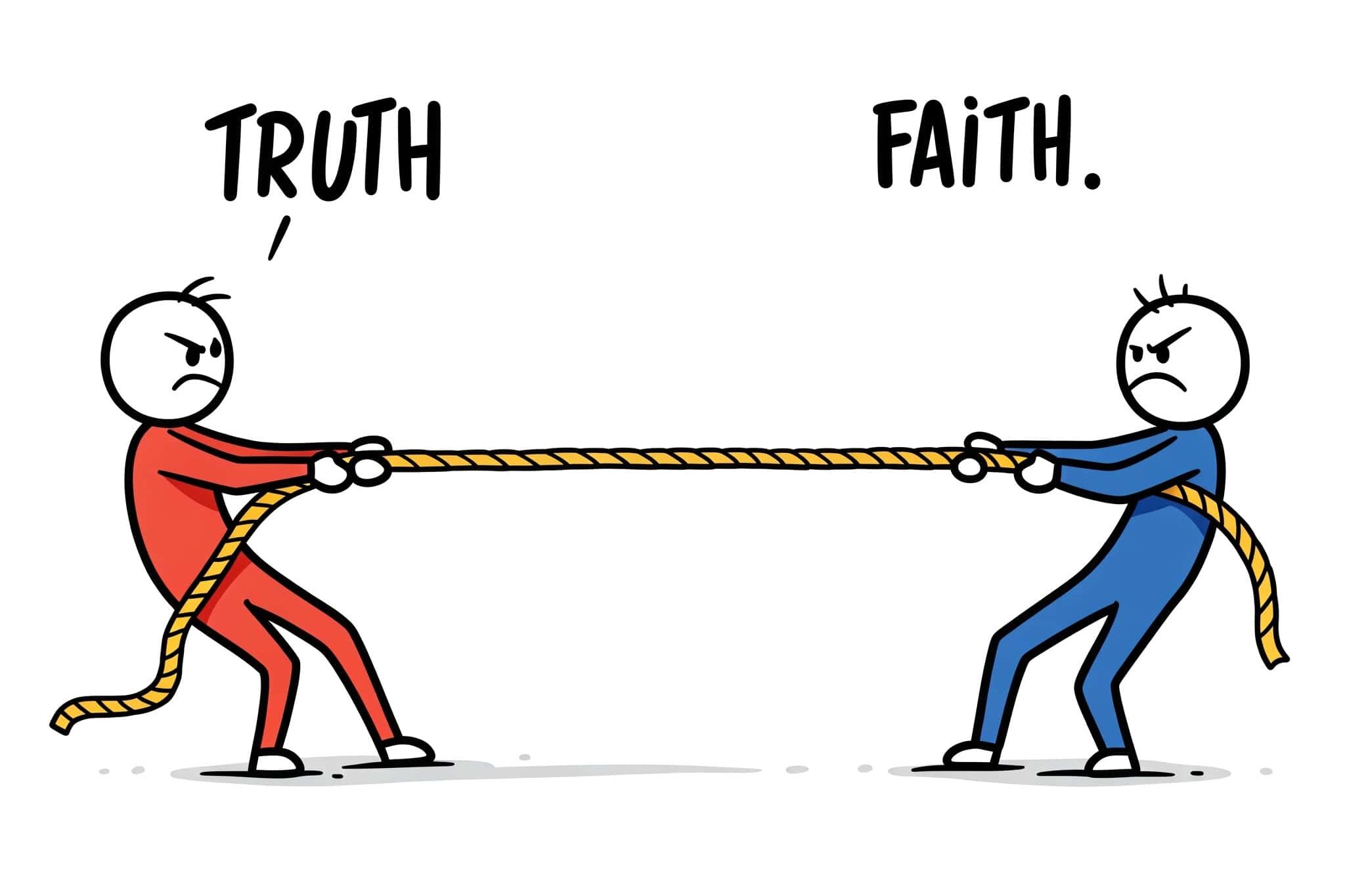
    The Bible does not depict a direct conflict between the pursuit of truth and faith; rather, it presents them as complementary.

    • Truth: Our confidence in a belief should be aligned with the strength of the evidence supporting it.
    • Faith: In areas where evidence-confidence is lacking, we are called to rely on faith-confidence in God.

    Importantly, faith is only reliable within the context of God due to His unchanging and trustworthy nature. Outside of this context, truth—rooted in evidence—should take precedence.

  • Marry Truth and Faith by separating them

    Marry Truth and Faith by separating them

    Truth and Faith are two words that carry multiple meanings depending on the context in which they are used. In many cases, their usage does not create conflict, but in other situations, they appear to be at odds with each other. Before delving into the conflict between truth and faith—specifically the pursuit of both—, it is important to establish what is meant by these terms in this discussion.

    What is meant by Truth?

    In this wiki entry What is Truth, I laid out the philosophical understanding of truth: it is that which is in accordance with fact or reality. This aligns with what most people intuitively mean when using the word truth. When we say, “That’s true,” we are asserting that a particular belief, statement, or proposition accurately represents reality.

    Thus, the pursuit of truth is the endeavor to form beliefs that accurately represents reality. There are two key aspects of the pursuit of truth that should be highlighted (will be further elaborated in future wiki entries):

    1. Human epistemic limitations: We are constrained by our human limitations and will never be fully certain that our beliefs are true.
    2. The pursuit of truth involves two key components*:
      1. Ensuring that the confidence we have in a belief is proportionate to the strength of the evidence supporting it.
      2. Actively seeking more evidence to refine and strengthen our beliefs.

    *(i) is more relevant as (ii) depends on the relevance/usefulness of the belief

    What is meant by Faith?

    In this wiki entry What is Faith, I laid out the biblical view of faith as a feeling of certainty/trust directed towards something, hoped for, that is not fully perceived or understood.

    However, when someone says, “you need to have faith”—in other words, pursuing faith—, they might mean one of the following

    1. Have or increase the feeling of trust, with no relation to the means to obtain it
    2. Increase the feeling of trust, beyond the level available evidence provides
    3. Increase the feeling of trust to the level that available evidence provides

    In conversations I have had, it is often unclear which of these meanings people adopt. For the purposes of this article, I will use the second definition since it aligns with the faith described in the wiki entry.

    In this article, I will use the following terms as defined below:

    • Evidence-confidence: confidence in the truth of a belief that arises from supporting evidence.
    • Faith-confidence: confidence in the truth of a belief that does not arise from evidence.
    • Total-confidence: the sum of evidence-confidence and faith-confidence.

    Why Marry Truth and Faith?

    Both the pursuit of truth and the pursuit of faith play significant roles in our lives.

    Seeking truth enables us to make well-informed decisions that effectively guide us toward our goals. In matters with serious consequences, truth should take precedence over faith—for instance, in determining criminal sentences or managing dangerous technologies.

    Meanwhile, the pursuit of faith—whether or not it is rooted in religion—contributes to personal motivation and relationship-building. In these areas, confidence based on faith can complement confidence grounded in evidence. For example:

    • People are naturally drawn to those who exude confidence, as it signals self-assurance and competence.
    • Trust tends to be reciprocated; when you trust others, they are more likely to trust you in return.

    The Conflict Between the Pursuit of Truth and Faith

    Pursuing faith discourages proportioning confidence with evidence

    One aspect of pursuing truth is to ensure that the level of evidence-confidence in a belief matches the strength of the available evidence. Confidence levels would vary from person to person, as individuals have access to different amounts of evidence when assessing the same belief or proposition.

    The standard of confidence to make decisions to use may differ based on the context. Different standards of proof (from high to low) is described below:

    • Beyond reasonable doubt: proof of such a convincing character that one would be willing to rely and act upon it without hesitation in the most important of one’s own affairs (does not mean that there’s no doubt)
    • Clear and convincing evidence: a level of proof such that a claim is substantially more likely to be true
    • Preponderance of the evidence: a level of proof such that that a claim is more likely to be true

    As Christians, we are called to pursue faith, specifically faith-confidence. However, I have observed that some fail to carefully distinguish between faith-confidence and evidence-confidence, often conflating the two. This issue is further compounded by the way we construct beliefs upon other beliefs. For example, if a foundational belief like “God does not lie” is accepted based on faith-confidence, then subsequent beliefs, such as “God will fulfill this promise,” are also adopted through faith-confidence rather than evidence-confidence. While this distinction may be clear when dealing with a single layer of belief, it becomes increasingly difficult to assess when multiple layers are involved.

    It can be challenging to determine the proportion of evidence-confidence and faith-confidence one has in a belief, thus making it difficult to evaluate whether one’s evidence-confidence aligns with the strength of the available evidence.

    Pursuing faith conflicts with pursuing evidence-confidence

    For someone who desires faith, the main goal would be to increase faith-confidence—confidence in the truth of a belief that does not arise from evidence. There is a limit to the amount of confidence that one could have of a belief, which is complete confidence. As such, the more faith-confidence that one has, the less room one would have for evidence-confidence, vice-versa.

    Furthermore, obtaining evidence-confidence requires significant effort: carefully evaluating evidence, considering counterarguments, and continuously refining one’s beliefs. Faith-confidence, particularly in the Christian context, is often described as a free gift from God. If one can achieve high total-confidence more easily through faith-confidence, there is less motivation to pursue evidence-confidence.

    Unfortunately, this is a inherent conflict and thus can never be resolved.

    Marry Truth and Faith by separating them

    Just like how we separate work from home to relax well at home and work efficiently, separating faith and truth can prevent unnecessary conflict between them.

    This does not mean ignoring the pursuit of truth in areas where one pursues faith. Rather, it means clearly distinguishing between faith-confidence and evidence-confidence. For example, one may have faith-confidence that a friend will return borrowed money despite contrary evidence-confidence. Being mindful of this distinction helps prevent biases in evaluating evidence-confidence.

    A practical guideline could be:

    • When engaging in truth-focused discussions (e.g. science, legal matters), avoid introducing faith-confidence.
    • When engaging in faith-focused discussions (e.g. theology, religious topics), avoid presenting faith-confidence as if it were evidence-confidence.
    • In areas where total-confidence is involved (e.g. apologetics—conversations between believers and non-believers), be explicit about what portion is derived from evidence-confidence versus faith-confidence.

    How this manifest in MTF

    MTF’s wiki structure is categorized into 3 categories

    Apologetics is where truth and faith coexist, a reasoned defense of the faith. There are instances where a truth-centered approach reveals evidence that challenges theological teachings. From what I’ve observed on other platforms, apologetic defenders often confuse faith-based confidence with evidence-based confidence. MTF aims to avoid this distinction: if a belief lacks supporting evidence, it simply cannot be considered supported by evidence.

    Similarly, in theology, while faith is central, truth should be considered as well. For example, teachings that seem contradictory should be acknowledged as such. Even if one could conceive of a context where they might not appear contradictory, if the context of those passages clearly reveals a contradiction, it should be accepted as contradictory. In the situation where two contradictory belief are held on faith-confidence, a revision must be made to reject either one of it. Evidence-confidence demands that both beliefs could not be true at the same time, there’s no room for faith-based confidence in such a context. Faith-based confidence only apply when there is a lack of evidence-confidence.

  • Reflection: MTF’s Launch

    Reflection: MTF’s Launch

    MTF’s first post! Finally launched MTF 😀

    My feelings at the moment

    As I am writing this, there are quite a lot of thoughts and feelings that are going through my mind, though not all would be included in this post.

    *For those reading, this first post would be minimally edited as an exception (future post / wiki articles would be edited more)

    MTF has been a project that I’ve been working on for close to half a year, on and off. Initially, I wanted to launch MTF by the end of 2024. But I have been procrastinating too much and the efforts needed has been more than what I had expected.

    Excited

    Since young, I have always been enthusiastic in reading books, watching videos and engaging in discussions on topics related to religion and Christianity. From Aug 2024, I started to write weekly on Medium on these topics, in an attempt to organize and share my thoughts to a wider audience. As I write more, I come to realize that I want a more structured way to organize the content that I write about, for both myself and for the people reading.

    Currently, there are two main type of content that I want to write about

    • Informal opinions (blog)
    • Structured timeless content (wiki) – not suited to be on Medium

    A blog – MTF – allows me the flexibility and control to include both content types and with more control over the content’s presentation.

    Worried

    Maintaining a blog involves much more effort as compared to simply writing on Medium. It involves web design, user engagement, marketing, SEO etc. While I intend to focus on producing quality content in the initial stage, the end goal that I have in mind is to build up a sizable audience which involves all these additional effort.

    From where I stand, this does not seem to be an easy task. I’m worried that I would give up too easily and not put in the required effort and time.

    Vision behind MTF

    As the name suggests, I envision MTF to be a space where faith and truth come together, complementing rather than opposing each other.

    Faith without Truth

    Faith without truth – often referred to as blind faith – involves holding firm beliefs despite a lack of rational basis or even in the face of contradictory evidence.

    Truth without Faith

    Truth without faith is the inability to accept any claim as true unless it is supported by absolute, indisputable proof.

    Balancing Truth and Faith

    A balanced approach to truth and faith involves holding beliefs with a degree of confidence that aligns with the available evidence. Rather than existing as absolutes, faith and truth operate on a spectrum, where some beliefs rely heavily on proof, while others require a measure of faith.

    • Faith with Truth: beliefs held by faith should be open to revision when faced with conclusive evidence to the contrary
    • Truth with Faith: allows for accepting truths where evidence is inconclusive, relying on faith to bridge the gap

    More in About Us page and would also be expanded upon in future blog post / wiki articles.

    MTF in the near future?

    My focus in the near future is to produce quality content, in both blog and wiki, including the following topics

    • Truth and Faith (top priority)
    • Arguments for God’s existence

    The approach I plan to take is likely to follow this sequence:

    1. Write structured wiki articles on these topics, incorporating key perspectives.
    2. Publish informal blog posts sharing my personal thoughts and experiences on these topics, while referencing the corresponding wiki articles.

    However, if there are any interesting thoughts or events unrelated to the above topics that I come across, I might write brief blog posts about it (without the corresponding wiki articles).